Great-Grandma’s Hot Rolls: Soft, One-Rise Dinner Rolls from Scratch
My great-grandma’s soft dinner rolls recipe with just one rise. 15 buttery rolls in a 9×13 pan, with high altitude adjustments included.
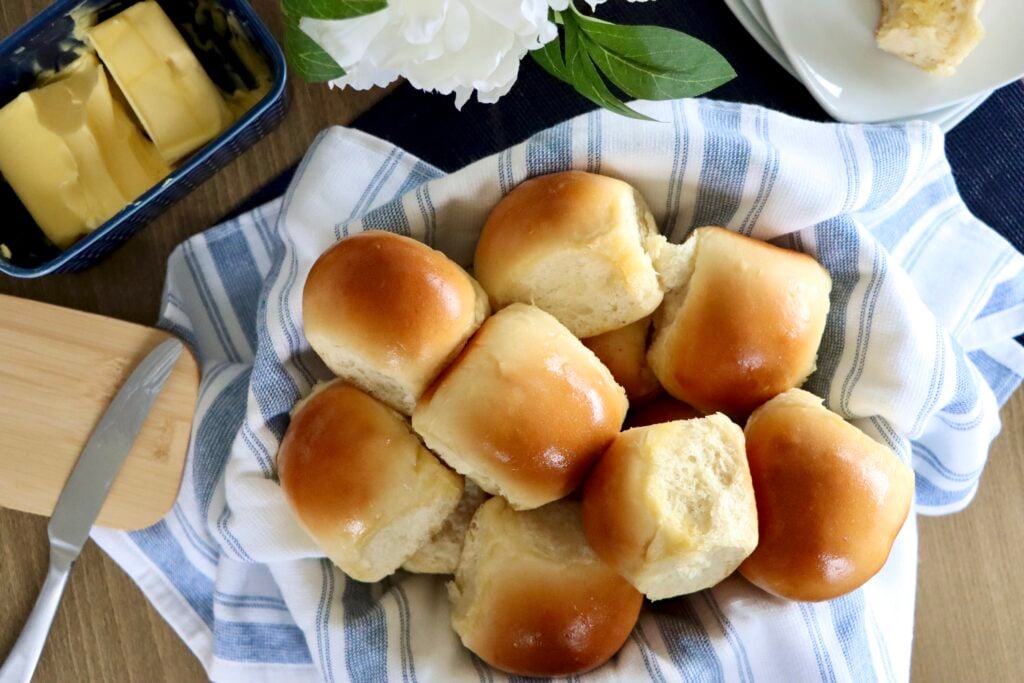
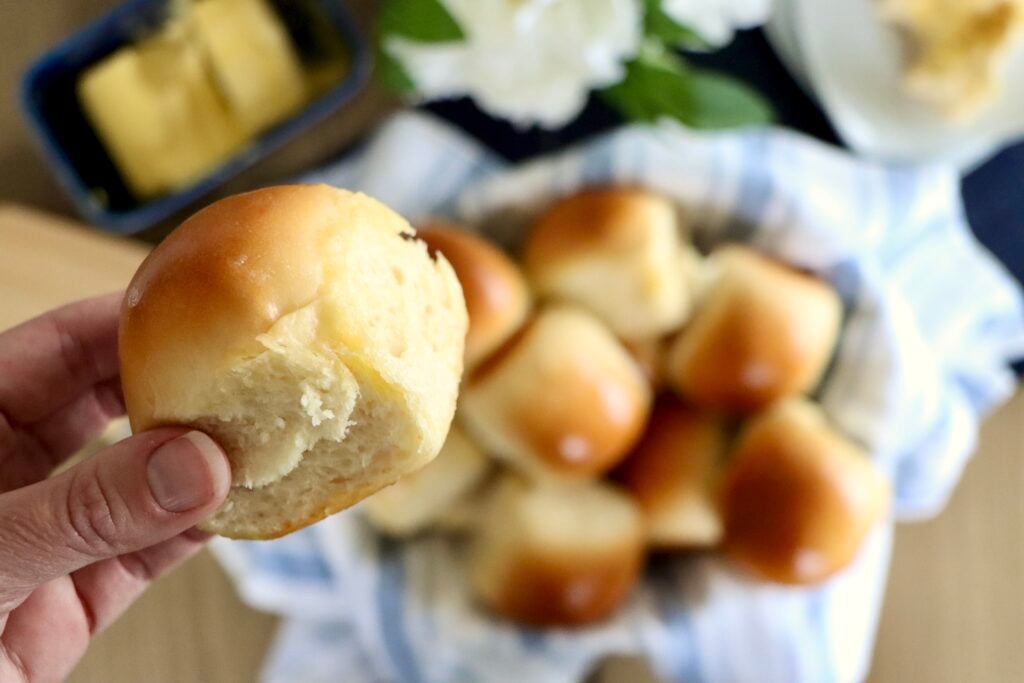
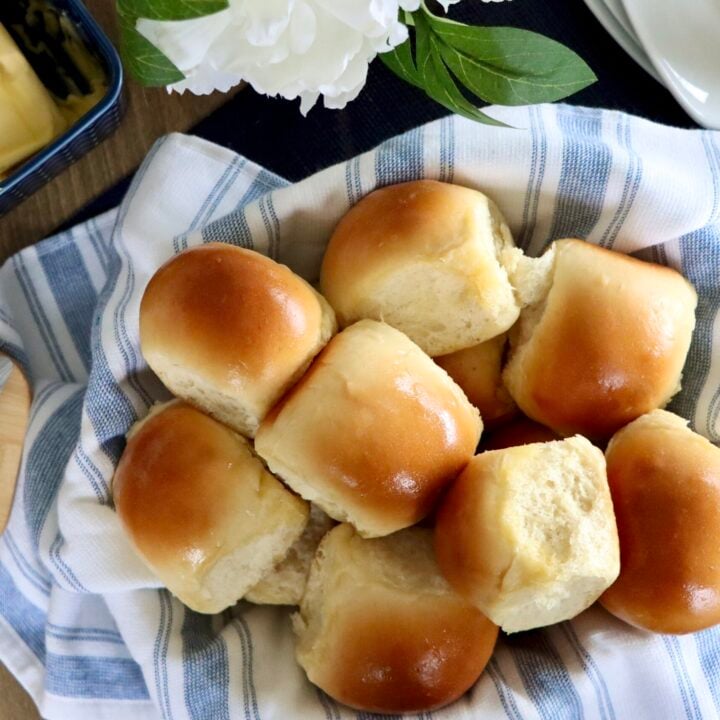
These easy homemade dinner rolls only rise once, so you can go from a pot of warm milk to a pan of 15 soft, buttery hot rolls in about 2½ hours. No all-day dough babysitting. No thermometer. Just real ingredients you already have, a stand mixer doing the hard work, and a 9×13 pan of golden rolls you’ll be pulling apart before they cool.
This recipe started with my great-grandma. These rolls were what she was known for. My grandma carried them on, making them in big batches for every family gathering, so if the whole family was around the table, a pan of hot rolls was too. Three generations later, they’re still the first thing to disappear.
In our family they’ve always just been “hot rolls,” because that’s how you eat them: hot, brushed with butter, straight out of the pan. And if you bake up high like I do at 7,053 ft, the high altitude adjustments are built right into the ingredient list. No guessing, no math.
Quick Answer: How do you make easy homemade dinner rolls? Warm 1 cup whole milk with ¼ cup sugar, 4 Tbsp butter, and 1 tsp salt. Mix it with 2 cups flour to cool it down, then add 1 egg, bloomed yeast, and 1½ more cups flour. Knead 8 minutes, rest 5, shape into 15 rolls in a buttered 9×13 pan, and let rise once until doubled (1–2 hours, faster at high altitude). Bake at 375°F for 20–25 minutes and brush with butter.
Homemade Dinner Rolls at a Glance
Why You’ll Love These One-Rise Dinner Rolls
Only one rise. A lot of dinner roll recipes call for two rises. These go straight from the mixer to the pan, rise once, and bake. That’s how homemade rolls fit into a regular weeknight.
The flour does the cooling. Instead of waiting for hot milk to cool down, you mix in the first 2 cups of flour and let the mixer bring the temperature down for you. It’s a simple, old-fashioned trick, and it means no thermometer.
A recipe with a track record. This is my great-grandma’s recipe, and my grandma baked it for every family gathering. It’s been feeding a crowd for generations.
8 simple ingredients. Flour, yeast, water, milk, sugar, butter, salt, and one egg. No 37-ingredient recipes here.
Pull-apart and crowd-friendly. 15 rolls baked snug in a 9×13 means soft sides, easy serving, and plenty for Thanksgiving dinner or a big pot of creamy homemade tomato soup.
Why This Dinner Roll Recipe Works
Whole milk, butter, sugar, and egg make an enriched dough. Fat and sugar tenderize the crumb, which is why these come out soft and fluffy instead of chewy like a crusty loaf.
8 minutes of mixer kneading builds structure. That’s enough gluten development to hold the rise and give you tall, even rolls. It’s the same principle behind my soft sourdough Hawaiian rolls, just with commercial yeast and a much shorter timeline.
Baking snug in one pan. When rolls rise into each other, they support each other and climb up instead of spreading out. That’s what gives you those tall, pull-apart sides.
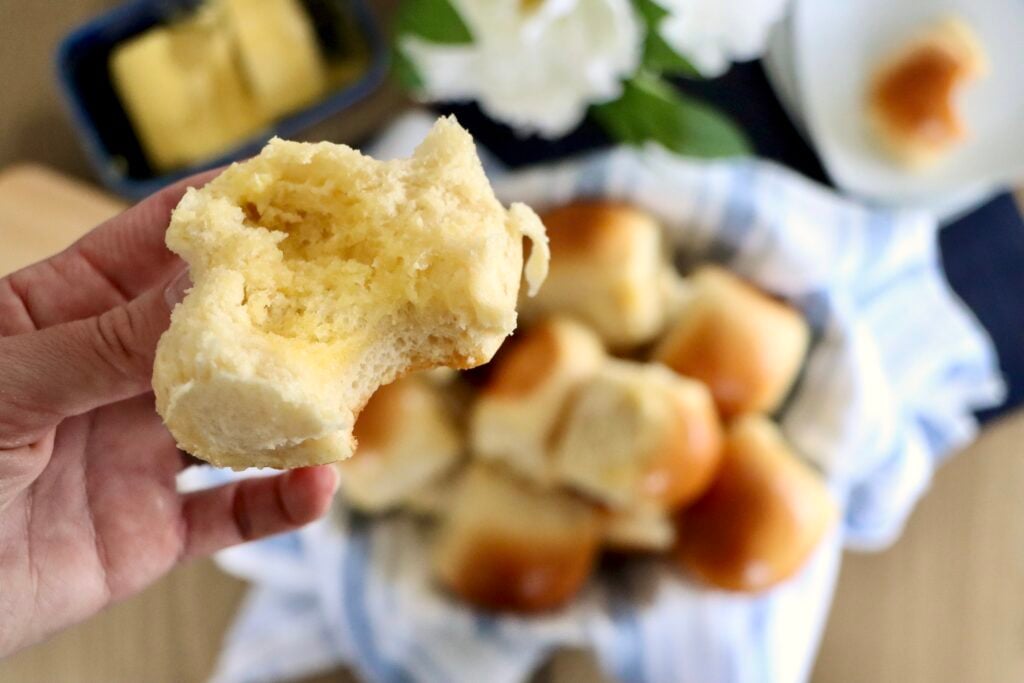
Ingredients for Homemade Dinner Rolls
Everything here is a pantry staple. Gram weights are included if you use a kitchen scale (I know some prefer that to measure flour), and high altitude adjustments are listed right next to each ingredient that needs one.
For the Yeast
- ½ Tbsp (1½ tsp) active dry yeast (use 1⅛ tsp at high altitude, which is 1 tsp plus a heaping pinch). Instant yeast works too and doesn’t need blooming.
- ¼ cup (60 ml) warm water (105–110°F), about the temperature of a comfortably warm bath. Too hot and you’ll kill the yeast.
For the Warm Milk Mixture
- 1 cup (240 ml) whole milk. Whole milk gives the richest, softest rolls. 2% works in a pinch.
- ¼ cup (50 g) granulated sugar
- 4 Tbsp (½ stick / 57 g) butter, plus extra for greasing the pan
- 1 tsp salt
For the Dough
- 3½ cups (420 g) all-purpose flour, divided into 2 cups (240 g) and 1½ cups (180 g) (at high altitude, hold back 2–3 Tbsp of the last 1½ cups and add it only if the dough is sticky). Bread flour also works and gives a slightly chewier roll.
- 1 large egg, room temperature
For the Tops
- 2 Tbsp butter, melted, for brushing right out of the oven
Equipment You’ll Need
A stand mixer with a dough hook (this is the mixer I use and love – I burned up two others before finding this one) makes this recipe nearly hands-off. You’ll also want a small saucepan, a 9×13 baking pan (metal gives the most golden bottoms, but I typically like to use my glass one), a bench scraper for dividing the dough, a kitchen scale for even rolls, and a pastry brush for the butter. I keep all the kitchen tools I actually use in my Amazon storefront.
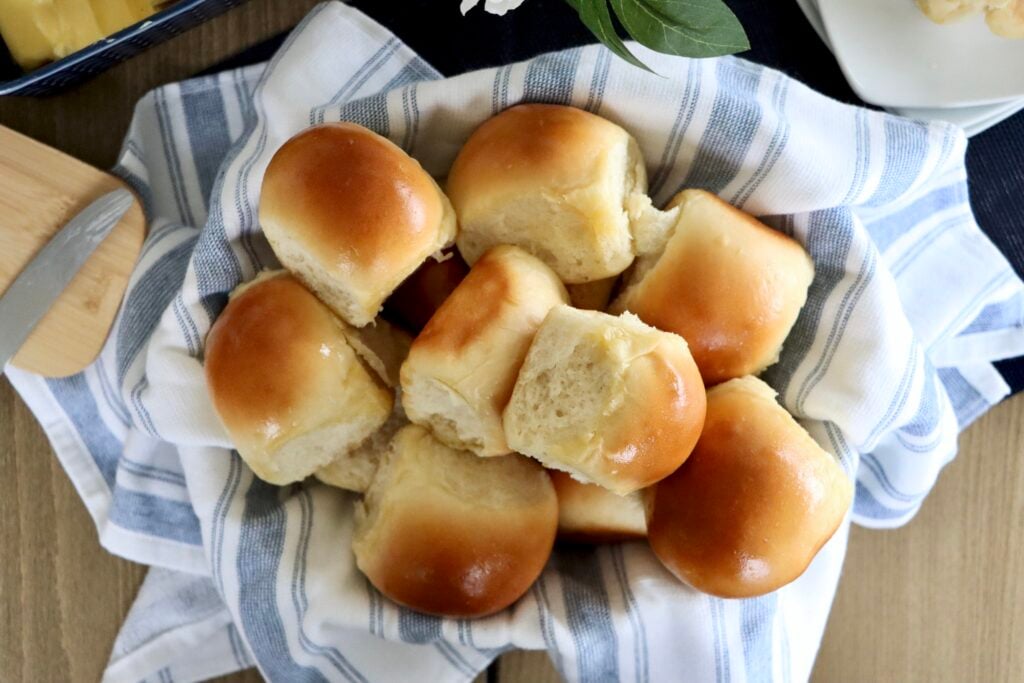
How to Make Homemade Dinner Rolls (Step by Step)
Prep the Pan and Bloom the Yeast
Butter a 9×13 pan generously, bottom and sides. In a small bowl, stir ½ Tbsp (1½ tsp) yeast (1⅛ tsp at high altitude) into ¼ cup warm water. Let it sit 5–10 minutes until it looks foamy and smells like bread. If it doesn’t foam, your yeast is expired or the water was too hot, so start over now rather than after an hour of rising.
Warm the Milk, Sugar, and Butter
In a saucepan over medium-low heat, warm 1 cup whole milk, ¼ cup sugar, 4 Tbsp butter, and 1 tsp salt, stirring until the butter melts and the sugar dissolves. You want it hot to the touch, not simmering. Pull it off the heat as soon as the butter is melted.
Let the Flour Cool It Down
Pour the warm milk mixture into your stand mixer bowl. Add 2 cups (240 g) of the flour and mix on low with the dough hook for 1–2 minutes. This thick, shaggy mixture drops the temperature fast. Touch the side of the bowl: it should feel warm, not hot, before you move on. If it’s still hot, give it another minute.
Add the Egg, Yeast, and Remaining Flour
With the mixer on low, add 1 egg and the foamy yeast mixture. Once combined, add the remaining 1½ cups (180 g) flour a little at a time. At high altitude, hold back 2–3 Tbsp and only add it if the dough is still sticking to the bottom of the bowl after a few minutes of kneading.
Knead for 8 Minutes
Knead on medium-low for about 8 minutes. The dough should be smooth, soft, and slightly tacky, pulling away from the sides of the bowl. Stretch a small piece thin: if it stretches without tearing right away (the windowpane test), you’re there.
Rest, Then Shape 15 Rolls
Let the dough rest in the bowl for 5 minutes. This relaxes the gluten so shaping is easier. Turn it out onto a clean counter and divide it into 15 equal pieces. For perfectly even rolls, weigh the whole dough and divide by 15. Each piece will be right around 58–60g. Roll each piece into a tight ball by cupping your hand over it and circling it on the counter. Arrange in the buttered pan in 3 rows of 5.
Let Them Rise Once
Cover the pan and let the rolls rise in a warm spot for 1–2 hours, until doubled and puffy enough that they’re touching. Preheat your oven to 375°F (390°F at high altitude) during the last 20 minutes. At high altitude, check at 45 minutes. Watch the dough, not the clock. Over-risen rolls can collapse in the oven. (More on that in the high altitude section below.)
How to tell they’re ready (the poke test): Flour a fingertip and gently press the side of a roll about ½ inch. If the dent springs back slowly and leaves a small impression, they’re ready. If it springs back right away, give them 10–15 more minutes. If it doesn’t spring back at all, get them in the oven now.
Bake Until Deep Golden
Bake for 20–25 minutes (start checking at 15–18 minutes at high altitude) until the tops are deep golden brown and the rolls sound slightly hollow when you tap the top. (If you have an instant-read thermometer, a center roll should read about 190°F, or 185°F at high altitude, since water boils at a lower temperature up here. It’s helpful but not required.) If the tops brown before the center is done, lay a sheet of foil loosely over the pan for the last 5 minutes.
Brush with Butter
Right out of the oven, brush the tops with 2 Tbsp melted butter. Let them cool 5 minutes in the pan, then pull apart and serve hot.
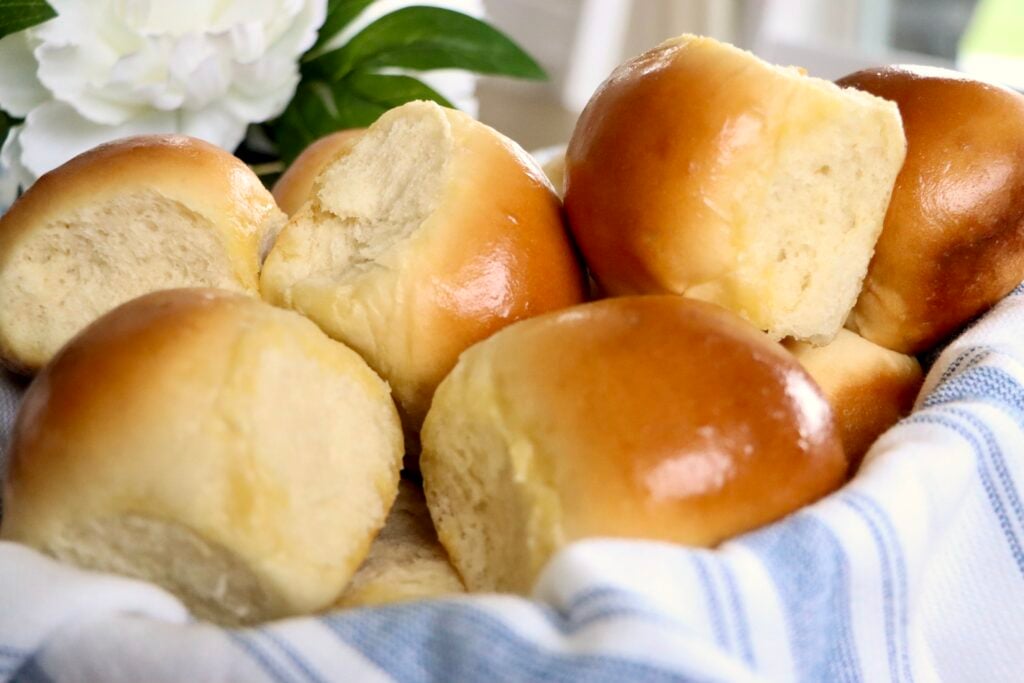
High Altitude Dinner Rolls: Adjustments for 7,053 ft
Baking yeast bread at high altitude isn’t harder. It’s just faster. Lower air pressure lets the gas from the yeast expand more quickly, so dough rises fast and can over-proof, then sink. Dry mountain air also means your flour is drier. Here’s exactly what I change at 7,053 ft in Colorado:
Use 25% less yeast. 1½ tsp becomes 1⅛ tsp. That slows the rise enough to build better flavor and structure.
Hold back a little flour. Drier flour absorbs more liquid, so the same 3½ cups can make a stiff dough up here. Hold back 2–3 Tbsp and add it only if you need it. If the dough still feels stiff, add warm water 1 Tbsp at a time.
Rise until just doubled, not a minute more. Start checking at 45 minutes and use the poke test above. Over-proofed dough is the number one reason rolls bake up flat or dense at altitude.
Cover with plastic wrap, not a towel. Dry air forms a skin on the dough under a towel.
Bake 15°F hotter. 390°F sets the structure faster, before the rolls can over-expand. Start checking at 15–18 minutes.
Quick reference for high altitude:
| Ingredient / Step | Sea Level | High Altitude (7,000+ ft) |
|---|---|---|
| Active dry yeast | 1½ tsp | 1⅛ tsp |
| Flour | 3½ cups (420 g) | Hold back 2–3 Tbsp; add only if sticky |
| Rise time | 1–2 hours | Check at 45 minutes |
| Oven | 375°F | 390°F |
| Bake time | 20–25 minutes | Check at 15–18 minutes |
| Done temp | 190°F | 185°F |
For the full rundown on adjusting any recipe, see my high altitude baking tips guide.
Tips for Soft, Fluffy Dinner Rolls
Don’t skip the bloom. Ten minutes of foam-checking saves you two hours of flat dough.
Keep the dough soft. Tacky dough makes fluffy rolls. Dry, stiff dough makes dense rolls. When in doubt, add less flour.
Tight balls = tall rolls. Take the extra 30 seconds per roll to shape them with a smooth, taut top.
Use a metal pan for golden bottoms. Glass works but bakes a little slower. Add 3–5 minutes.
Troubleshooting Homemade Dinner Rolls
My rolls didn’t rise. The yeast was likely expired or killed by liquid that was too hot. Always check that the yeast foams, and make sure the milk mixture feels warm, not hot, before the yeast goes in. A cold kitchen can also slow things way down. Try the oven with just the light on.
My rolls are dense. Usually too much flour or under-proofing. Measure by weight or spoon and level, keep the dough slightly tacky, and let the rolls fully double.
My rolls rose, then collapsed or baked flat. They over-proofed. This is really common at high altitude. Use less yeast, start checking early, and bake as soon as the poke test says they’re ready.
The tops are too dark but the middle is doughy. Your oven may run hot, or the pan is on too high a rack. Bake on the center rack and tent loosely with foil for the last 5 minutes.
My rolls are dry. They baked too long or the dough had too much flour. Pull them at 190°F (185°F at altitude) and don’t skip the butter brush.
Dinner Roll Variations
- Honey butter tops: Stir 1 Tbsp honey into the melted butter before brushing.
- Garlic herb rolls: Brush with my garlic herb compound butter instead of plain butter.
- Cinnamon sugar: Brush with butter and sprinkle cinnamon sugar for a breakfast-worthy roll.
- Half whole wheat: Swap 1 cup of the flour for whole wheat flour. Expect a slightly denser, nuttier roll.
- Hamburger buns: Divide into 8 pieces, flatten slightly, and bake 18–22 minutes. Or use my dedicated quick hamburger buns recipe, and my quick hot dog buns for cookout night.
- Baking for a crowd: Do it the way my grandma did and double the batch. Double every ingredient, knead in two batches if your mixer is small, and bake in two buttered 9×13 pans. You’ll get 30 rolls.
How to Make Dinner Rolls Ahead, Store, and Freeze
Overnight rise: Shape the rolls, cover tightly, and refrigerate up to 18 hours. Let them sit at room temperature about 1 hour until puffy, then bake as directed. A great way to take one thing off your Thanksgiving morning list.
Room temperature: Store cooled rolls in an airtight container up to 3 days.
Freeze: Freeze baked, cooled rolls in a freezer bag up to 3 months. Thaw on the counter.
Reheat: Wrap in foil and warm at 300°F for 10–12 minutes, or microwave a single roll for 10–15 seconds.
Thanksgiving Dinner Rolls Timeline
Rolls are one of the easiest things to plan around on a busy holiday. Pick the option that fits your day.
Same day, fresh from the oven (for a 5:00 pm dinner): Start the dough at 2:00 pm. Rolls are shaped and rising by about 2:25, into the oven around 4:15, and out by 4:40. Brush with butter and they’re perfectly warm at 5:00. At high altitude, your rolls may be ready to bake closer to 3:15–3:30, so plan to have the oven free earlier.
Night before: Shape the rolls the evening before and refrigerate. Pull them out about 1 hour before baking, then bake while the turkey rests.
Weeks ahead: Bake, cool, and freeze. Thaw on the counter Thanksgiving morning, then reheat wrapped in foil at 300°F for 10–12 minutes right before dinner.
What to Serve with Hot Rolls
These are great for soup night. Try them with my creamy homemade tomato soup, hotdog potato soup, creamy sausage tortellini soup, or a big pot of homemade chili.
They also belong on the Thanksgiving or Christmas table next to turkey, gravy, and my creamy baked macaroni and cheese, and they’re the perfect thing to have warm while a pumpkin pie, Dutch apple pie, or apple crisp bakes for dessert.
Frequently Asked Questions
Can you make dinner rolls with only one rise?
Yes. Enriched doughs like this one, with milk, butter, sugar, and egg, rise well in a single proof after shaping. You skip the bulk rise and still get soft, fluffy rolls in about 2½ hours total.
Why are my homemade dinner rolls dense?
Usually one of three things: too much flour (scooped instead of spooned), dead yeast, or under-proofing. At high altitude, over-proofing can also cause rolls to collapse and bake up dense. Keep the dough soft and bake once the rolls have just doubled.
How do I know when dinner rolls are done?
Look for deep golden tops and an internal temperature around 190°F (185°F at high altitude). The rolls should sound slightly hollow when tapped on top.
Can I use instant yeast instead of active dry?
Yes. Use the same amount and skip the bloom. Add the yeast and the ¼ cup warm water directly to the mixer with the egg.
Can I use bread flour for dinner rolls?
Yes. Bread flour has more protein, so your rolls will be a little taller and chewier. You may need an extra tablespoon or two of milk or water to keep the dough soft.
Should you brush rolls with butter before or after baking?
After. Brushing melted butter on hot rolls right out of the oven soaks in and keeps the tops soft and glossy. Brushing before baking can make the tops brown too fast.
How many rolls fit in a 9×13 pan?
15 rolls in 3 rows of 5 is ideal. They bake snug, support each other as they rise, and come out tall with soft pull-apart sides.
How do you adjust yeast rolls for high altitude?
Reduce the yeast by about 25%, hold back a little flour, let the dough rise only until just doubled, and bake 15–25°F hotter. At 7,053 ft, this recipe uses 1⅛ tsp yeast and bakes at 390°F.
Can I make dinner rolls without a stand mixer?
Yes. Mix with a wooden spoon, then knead by hand on a lightly floured counter for 10–12 minutes until smooth and elastic.
Can I make these rolls the day before Thanksgiving?
Yes, two ways. Bake them a day ahead and reheat wrapped in foil, or shape them and refrigerate overnight, then bake fresh the next day.
How long do homemade dinner rolls last?
Up to 3 days in an airtight container at room temperature, or up to 3 months in the freezer.
What’s the difference between hot rolls and dinner rolls?
Nothing, really. “Hot rolls” is an old-fashioned, regional name for soft yeast dinner rolls meant to be served warm from the oven.
Final Thoughts
This recipe has been on my family’s table for three generations, and I’m so happy it gets to be on yours now. If homemade rolls have always felt like a whole-day project, this is your sign to try them this week. One rise, 8 real ingredients, and a pan of warm, buttery rolls that’ll disappear faster than you can brush them. 💛
If you make them, leave a comment and a star rating, and tell me your elevation and how they turned out. I read every single one. And come hang out with me on Instagram, YouTube, and Facebook for more everyday cooking, sea level to high altitude. Ready to try bread without commercial yeast next? Start with my easy 5-day sourdough starter guide.
Don’t forget to pin this for later!

Great-Grandma's Hot Rolls (One-Rise Dinner Rolls)
My great-grandma's soft, buttery homemade dinner rolls with only one rise. 15 pull-apart rolls in a 9x13 pan, made with 8 real ingredients, with high altitude adjustments included.
Ingredients
- 1½ tsp (½ Tbsp) active dry yeast (1⅛ tsp for high altitude)
- ¼ cup (60 ml) warm water (105–110°F)
- 1 cup (240 ml) whole milk
- ¼ cup (50 g) granulated sugar
- 4 Tbsp (57 g) butter, plus more for the pan
- 1 tsp salt
- 3½ cups (420 g) all-purpose flour, divided (hold back 2–3 Tbsp for high altitude)
- 1 large egg, room temperature
- 2 Tbsp butter, melted, for brushing
Instructions
- Butter a 9x13 pan. Stir 1½ tsp yeast (1⅛ tsp for high altitude) into ¼ cup warm water and let sit 5–10 minutes until foamy.
- In a saucepan over medium-low heat, warm 1 cup whole milk, ¼ cup sugar, 4 Tbsp butter, and 1 tsp salt just until the butter melts. Do not boil.
- Pour the milk mixture into a stand mixer bowl, add 2 cups flour, and mix on low with the dough hook 1–2 minutes until the bowl feels warm, not hot.
- Add 1 egg and the yeast mixture. Gradually add the remaining 1½ cups flour (hold back 2–3 Tbsp for high altitude and add only if the dough is sticky).
- Knead on medium-low for 8 minutes until smooth, soft, and slightly tacky.
- Rest the dough 5 minutes. Divide into 15 equal pieces (about 58–60 g each), roll into tight balls, and arrange in the pan in 3 rows of 5.
- Cover and let rise 1–2 hours until doubled (check at 45 minutes for high altitude; cover with plastic wrap). Preheat oven to 375°F (390°F for high altitude).
- Bake 20–25 minutes (check at 15–18 minutes for high altitude) until deep golden and about 190°F inside (185°F for high altitude).
- Brush tops with 2 Tbsp melted butter. Cool 5 minutes and serve warm.
Notes
- Instant yeast: Use the same amount and skip the bloom; add with the egg and water.
- High altitude (tested at 7,053 ft): Reduce yeast by 25%, hold back 2–3 Tbsp flour, rise only until just doubled, bake at 390°F. If the dough feels stiff, add warm water 1 Tbsp at a time.
- Make ahead: Shape, cover, and refrigerate up to 18 hours. Rest 1 hour at room temperature before baking.
- Storage: Airtight at room temperature up to 3 days, or freeze baked rolls up to 3 months. Reheat wrapped in foil at 300°F for 10–12 minutes.
- Glass pan: Add 3–5 minutes to the bake time.
- Ready to bake? A floured fingertip pressed into a roll should leave a dent that springs back slowly.
Nutrition Information:
Yield: 15 Serving Size: 1 RollAmount Per Serving: Calories: 286Total Fat: 6gSaturated Fat: 3gUnsaturated Fat: 3gCholesterol: 26mgSodium: 195mgCarbohydrates: 50gFiber: 2gSugar: 5gProtein: 7g
Nutrition facts are calculated automatically and are approximate.